






The Contractor Who Never Left
Six months ago, Priya finished her contract with a mid-sized financial services company. She packed her laptop, returned her security badge, and walked out the door. Her manager signed the exit paperwork. HR marked her file as “terminated.” Everyone moved on.
Except Priya never really left.
Her Active Directory account? Still active. Her access to the customer database? Still granting queries. Her privileged credentials for the payment processing system? Still authenticating. Her cloud accounts across seventeen different SaaS platforms? All operational, all waiting, all invisible.
Nobody planned this. Nobody wanted this. But weak identity controls transformed what should have been a simple offboarding into a ticking security timebomb. In the shadowy world where digital access should end but often doesn’t, Priya became what security professionals call a “digital ghost.” And she’s far from alone.
This isn’t just poor housekeeping-it’s a catastrophic vulnerability that weak identity controls enable every single day across enterprises worldwide.
The Three Invisible Catastrophes of Weak Identity Controls
While enterprises obsess over firewalls and encryption, weak identity controls are creating attack surfaces so large, so exploitable, that traditional security measures become almost meaningless. Three intertwined failures in identity governance are happening right now, quietly expanding in every organization that hasn’t looked hard enough at who has access to what.
The Digital Ghost Problem: Orphaned Accounts
Let’s start with the uncomfortable truth: Weak identity controls have turned your organization into a haunted house. Not by spirits, but by accounts that should be dead but refuse to die.
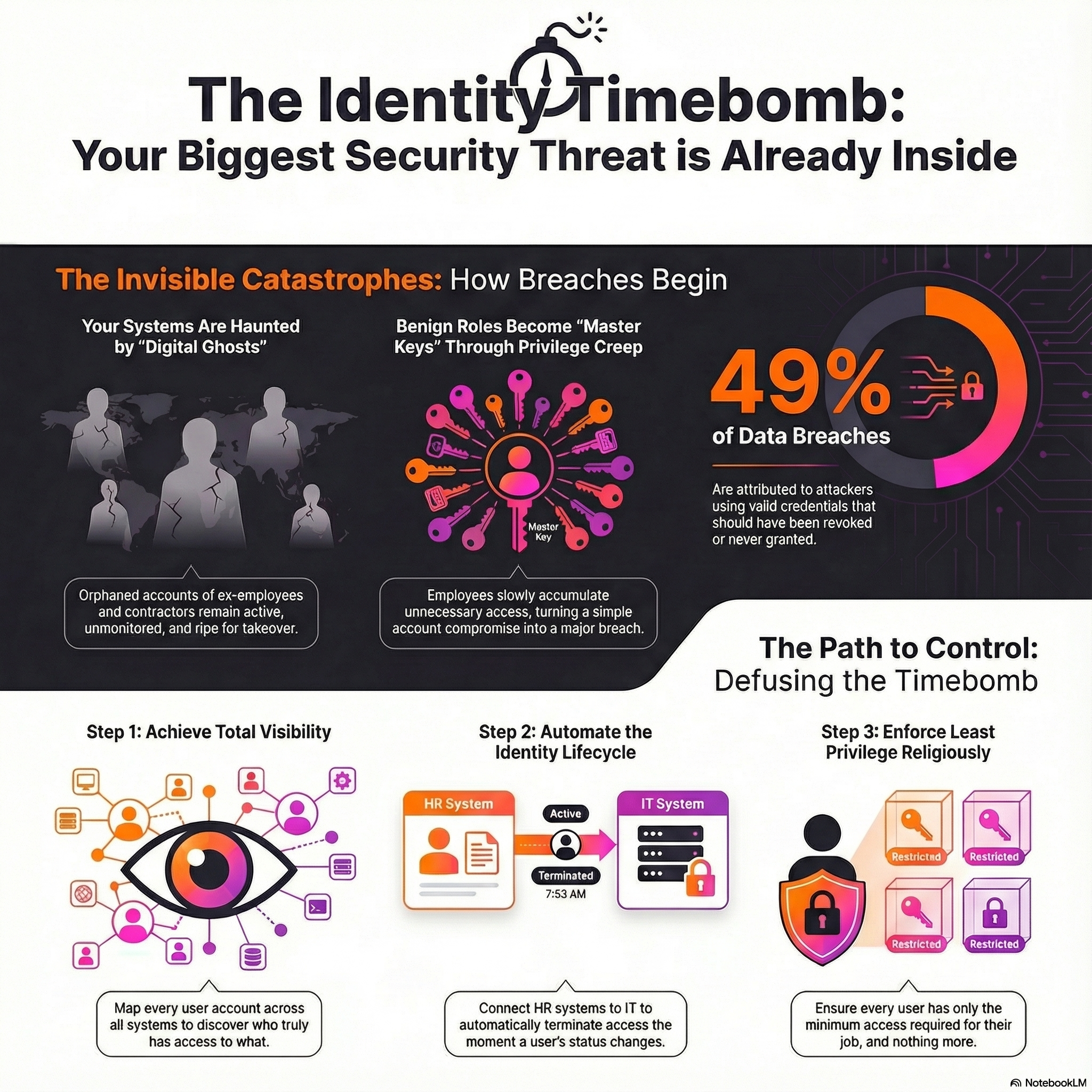
Orphaned accounts-inactive or unowned user identities that retain access to critical systems-represent one of the most overlooked consequences of weak identity controls. These are the accounts that belonged to employees who left, contractors whose engagements ended, interns who finished their summer stint, or even merger acquisitions where redundant identities were never properly cleaned up.
Picture this: A vendor completes a six-month security audit. Their consultant had VPN access, remote desktop privileges, and administrative rights to several monitoring systems. The project wraps up. The invoice gets paid. Everyone celebrates. But weak identity controls mean nobody-absolutely nobody-remembers to revoke the consultant’s access credentials. Third-party identities are more likely to avoid MFA, access reviews, and internal compliance because they are “external”.
Months later, that account is still there. Still authenticated. Still holding the keys to systems that were supposed to be locked tight.
The breeding grounds for these digital ghosts are everywhere. HR communicates terminations to IT, but weak identity controls mean the message doesn’t reach every system administrator. Employees transfer departments and get new access, but keep the old. Orphan accounts are typically created during employee turnover, mergers and acquisitions, role changes or reorganizations, system upgrades, and migrations.
What makes orphaned accounts particularly dangerous? They’re unmonitored, often overprivileged, and completely invisible to security teams conducting standard reviews. Malicious actors exploit orphan accounts through techniques like credential stuffing, password guessing, and lateral movement to infiltrate systems and escalate privileges. When attackers compromise these forgotten identities, there’s no one watching. No behavioral baseline exists. No alerts trigger. The breach moves silently through systems that trust a credential they shouldn’t.
The Snowball Effect: Privilege Creep
Now imagine this scenario: Rajesh joins as a junior analyst in the operations team. He gets standard access-email, shared drives, the ticketing system. Nothing sensitive. Six months later, he temporarily helps with a critical project and receives database access. The project ends, but weak identity controls ensure the access stays. A year passes. Rajesh takes on new responsibilities in reporting. He needs access to financial systems. Granted. Another six months. He fills in for a colleague on vacation and gets temporary admin rights to the customer portal. Temporary becomes permanent because weak identity controls don’t enforce revocation policies.
Three years in, Rajesh has accumulated access to seventeen different systems, twelve of which he hasn’t touched in months. Privilege creep often occurs when an employee changes job responsibilities within an organization and is granted new privileges. He’s not trying to be a security risk. He doesn’t even realize how much access he has. But if his credentials get compromised-through phishing, malware, or simple password theft-an attacker doesn’t just get the keys to one room. They get a master key to nearly every critical system in the organization.
This is privilege creep, and it thrives wherever weak identity controls exist. If users have obtained more privileges than they need, they allow cybercriminals to move laterally to have broad control over the organization’s network and access sensitive data.
The pattern repeats across enterprises everywhere. Promotions grant new access without removing old access. Temporary crisis situations create emergency permissions that nobody remembers to revoke. When an employee changes jobs internally or gets new responsibilities, their access requirements change too-they’ll get granted new privileges but might still retain old, unnecessary ones. Team members share credentials “just this once” to keep projects moving, creating informal access pathways that bypass every security control. Managers approve access requests without really understanding what they’re approving, because weak identity controls don’t provide adequate visibility or accountability.
The truly terrifying part? Most organizations have no idea how bad their privilege creep situation is because weak identity controls prevent them from seeing it. They can’t map every employee’s actual access across every system. They assume their role-based access controls are working, when in reality, roles are theoretical constructs that bear little resemblance to actual permission sets.
When attackers breach an over-privileged account, they don’t just steal data-they escalate quickly. A standard user with unnecessary admin rights can quickly escalate privileges or move laterally, accessing sensitive data or critical systems. What should have been a contained incident becomes a full-blown catastrophe, all because weak identity controls allowed unnecessary access to accumulate unchecked.
The Governance Vacuum: Where Weak Identity Controls Begin
Here’s where everything connects-and falls apart. Orphaned accounts exist because of weak identity controls. Privilege creep thrives because weak identity controls are reactive rather than proactive. And weak identity controls create the perfect storm where both problems metastasize beyond control.
Weak identity controls have continually given bad actors an easy path to gaining access to enterprise data. But what does this actually mean in practice?
It means organizations have no single source of truth for who has access to what. Identity repositories are scattered-Active Directory here, cloud identity providers there, legacy systems with their own authentication mechanisms everywhere else. Each operates independently, creating silos that make comprehensive visibility impossible. This fragmentation is the hallmark of weak identity controls.
It means access reviews happen once a year, if at all, through spreadsheets sent to managers who approve everything without reading because they have fifty other priorities. Organizations that lack standardized onboarding and offboarding processes typically struggle to manage user identities across systems, especially with nonhuman accounts, contractors and temporary workers. The process is manual, tedious, and fundamentally broken-classic symptoms of weak identity controls.
It means there’s no automated connection between HR systems and identity management systems. When someone leaves, HR knows. IT knows. But do all seventeen SaaS platforms know? Does that ancient ERP system know? Do the service accounts that employee created for automation scripts know? Weak identity controls ensure the answer is usually no.
It means nobody has clear ownership of identity security. IT thinks security is handling it. Security thinks IT is handling it. Meanwhile, weak identity controls allow identities to proliferate unchecked, permissions to accumulate like dust, and the attack surface to grow larger every single day.
Consider what happens when weak identity controls collide with real threats. Attackers don’t need sophisticated zero-day exploits when orphaned contractor accounts with administrative privileges are lying around. They don’t need elaborate social engineering when privilege creep has given half the organization access to sensitive systems. Attackers can use a range of tactics, including phishing, malware, and social engineering, to gain access to enterprise systems and data.
The absence of strong governance turns your organization into a treasure trove for attackers. Every orphaned account is an unlocked door. Every over-privileged user is a potential escalation path. Every untracked identity is a blind spot where breaches can hide and spread.
Learn more about building robust identity security frameworks from the Identity Defined Security Alliance.
The Path to Control: Fixing Weak Identity Controls
So how do you close these massive attack surfaces created by weak identity controls? The answer isn’t a single tool or technology-it’s a fundamental shift in how organizations think about identity.
Start with brutal visibility. You cannot secure what you cannot see, and weak identity controls thrive in darkness. Implement comprehensive identity discovery that maps every account across every system-cloud, on-premises, legacy, modern, human, and non-human. Identity Governance and Administration tools can help through robust identity lifecycle management capabilities that automatically provision and deprovision access whenever someone joins, moves, or leaves a role in the organization. Don’t trust your org chart or your assumptions. Build an actual inventory.
Connect HR to identity systems in real-time. Weak identity controls persist when your Human Resources Information System and Identity Governance Platform don’t communicate in real-time. When someone leaves, their access should terminate automatically across all systems-not next month during a manual cleanup, but immediately. When someone changes roles, their old privileges should be reviewed and removed within days, not years.
Enforce least privilege religiously. Every user should have exactly the access they need for their current role and nothing more. Ensure least privilege: After gaining access to an organization’s network, users are limited to the minimum amount of network access they need to perform their jobs. This requires defining roles clearly, mapping permissions to those roles, and continuously validating that people haven’t accumulated extras over time.
Automate access reviews that actually work. Forget the annual spreadsheet exercise that nobody takes seriously-that’s a symptom of weak identity controls. Implement continuous access certification where managers receive targeted, specific questions about individual access rights. “Does Sarah still need administrative access to the finance system?” is answerable. “Review all of Sarah’s access” gets rubber-stamped. Make the reviews frequent, focused, and impossible to ignore.
Hunt for orphaned accounts systematically. Schedule regular scans comparing identity repositories against HR records. When HR marks someone as terminated but IT doesn’t immediately revoke access, orphaned accounts stay live. Flag accounts with no recent activity. Cross-reference SaaS platform users against your official employee list. Build automated workflows that suspend dormant accounts after defined periods and delete them after verification.
Implement role-based access controls properly. Not the theoretical RBAC that looks good in documentation, but actual role definitions that reflect how work happens. Using roles, organizations have solid, predefined, and preapproved access policies in place, and know specifically which access privileges each person needs and what access to remove-reducing the chances for orphaned accounts and eliminating weak identity controls.
Treat service accounts and non-human identities seriously. These often-forgotten identities are just as dangerous as human accounts when compromised, and weak identity controls typically overlook them entirely. Every API key, every service account, every automation credential needs an owner, a purpose, and regular review cycles. If nobody can explain why it exists, it shouldn’t.
The Real Enemy is Complacency
The most dangerous thing about weak identity controls isn’t their technical complexity. It’s how normal they feel. Orphaned accounts seem like harmless oversight. Privilege creep feels like flexibility. Weak identity controls look like pragmatism.
Until the breach happens.
A significant portion of data breaches are attributed to unauthorized access. That’s not sophisticated nation-state hacking. That’s attackers using valid credentials that shouldn’t exist, accessing systems through accounts that should have been terminated, exploiting privileges that should have been revoked months ago-all made possible by weak identity controls.
Your organization probably has hundreds-maybe thousands-of digital ghosts haunting your systems right now. Users with access they don’t need. Accounts with permissions they shouldn’t have. Identities that exist in systems nobody’s looked at in years. Weak identity controls allow all of this to flourish in the shadows.
The question isn’t whether these vulnerabilities exist. They do. The question is what you’re going to do about weak identity controls before an attacker finds them first.
Because in the world of identity security, what you can’t see absolutely can hurt you. And right now, weak identity controls are probably keeping you blind to more than you realize.
Frequently Asked Questions (FAQ)
Understanding Digital Identity Risks
Q: What is a “digital ghost”?
A: A “digital ghost” is a term security professionals use for orphaned accounts, which are inactive or unowned user identities that retain access to critical systems even though they should be terminated. These accounts commonly belong to employees who have left, contractors whose engagements have ended, or identities that were never properly cleaned up after a merger or acquisition.
Q: Why are orphaned accounts considered a major security risk?
A: Orphaned accounts pose a high risk because they are typically overprivileged, unmonitored, and completely invisible to security teams conducting standard reviews. If compromised by malicious actors using techniques like password guessing or credential stuffing, the breach can move silently through systems because there is no existing behavioral baseline and no alerts trigger.
Q: How does “privilege creep” occur?
A: Privilege creep happens when an employee accumulates more access privileges than they strictly need for their current role. This is frequently seen when employees change jobs internally or take on new responsibilities, resulting in them being granted new access while retaining old, unnecessary privileges. Temporary rights granted during projects or crises often become permanent because the process to revoke them is neglected.
Q: What is the danger of an over-privileged account?
A: If the credentials of an over-privileged account are compromised-such as through malware or phishing-an attacker gains a “master key” to many critical systems instead of just one. This allows cybercriminals to move laterally and quickly escalate privileges, leading to broad control over the organization’s network and access to sensitive data.
Addressing Governance Failures
Q: What is weak identity governance?
A: Weak identity governance describes failures in the access systems where identity controls are insufficient, giving bad actors an easy path to gain access to enterprise data. In practice, this means organizations lack a single source of truth for access, identity repositories are scattered across different systems (like Active Directory, cloud providers, and legacy systems), and there is often no automated, real-time connection between HR systems and identity management systems.
Q: How do weak identity controls contribute to security breaches?
A: The absence of strong identity governance creates a scenario where attackers do not need zero-day exploits; instead, they can use valid credentials that shouldn’t exist, accessing systems through accounts that should have been terminated.
Q: Are annual access reviews sufficient to manage identity risks?
A: Annual access reviews are typically insufficient, especially if they are manual and rely on spreadsheets sent to busy managers who often approve everything without reading. This process is described as tedious, manual, and fundamentally broken. Effective access control requires continuous access certification with targeted, specific questions about individual rights, making the reviews frequent, focused, and impossible to ignore.
The Path to Control
Q: What is the first step an organization must take to address identity governance issues?
A: The crucial first step is to gain “brutal visibility”. Organizations must implement comprehensive identity discovery to map every account across every system, including cloud, on-premises, legacy, modern, human, and non-human identities, to build an accurate inventory.
Q: How can organizations prevent digital ghosts and privilege creep?
A: The solution requires a fundamental shift, focusing on proactive controls. Organizations should implement robust identity lifecycle management using Identity Governance and Administration (IGA) tools to automatically provision and deprovision access when an individual joins, moves, or leaves a role. Furthermore, they must rigorously enforce the principle of least privilege, ensuring every user has exactly the access necessary for their current role and nothing more.
Q: What role does HR play in securing identities?
A: HR systems must be connected to identity systems in real-time. When someone leaves the organization, their access should terminate automatically across all systems immediately, not during a manual cleanup later. Organizations can use HR records to systematically hunt for orphaned accounts by comparing identity repositories against HR records.
Q: Should service accounts and non-human identities be treated the same as human accounts?
A: Yes, we emphasize that service accounts, API keys, and other non-human identities are just as dangerous when compromised as human accounts. These identities must be taken seriously, with every credential requiring an owner, a purpose, and regular review cycles.
At Insnapsys, we’ve spent some good time helping enterprises eliminate weak identity controls and regain command over their identity sprawl. We don’t pretend identity governance is easy-we know it’s messy, complex, and requires sustained effort. But we also know it’s fundamental. Every security investment you make becomes stronger when you know who has access to what, and weaker when weak identity controls persist. Let us help you see what’s hiding in your identity landscape-because the first step to solving these problems is admitting they exist.
Ready to strengthen your identity controls? Contact Insnapsys today to discuss how we can help secure your enterprise.