Autonomous Knowledge Worker
A writer agent researches your corpus. A reviewer agent checks every claim before you see it.
- Client
- Enterprise knowledge and compliance teams
- Sector
- Enterprise knowledge and compliance
- Our role
- Retrieval architecture, agent design, and evaluation
- Status
- Running in production
The brief
What was breaking
Synthesising a cited report from a large document corpus is hours of skilled work per task, and most of those hours are spent locating source material rather than reasoning about it. Generic assistants speed up the drafting and make the citation problem worse, because a confident, unsourced answer is harder to check than no answer at all.
- Research means reading across hundreds of documents to assemble something that already exists in fragments.
- Answers without verifiable sources cannot be used in legal, compliance, or audit contexts, however fluent they are.
- Off-the-shelf chatbots produce generic output because retrieval quality, not model choice, is what determines usefulness on a specific corpus.
- Nobody finds out the answer quality has drifted until a user complains about it.
What we built
The system we delivered
A retrieval layer built for the corpus
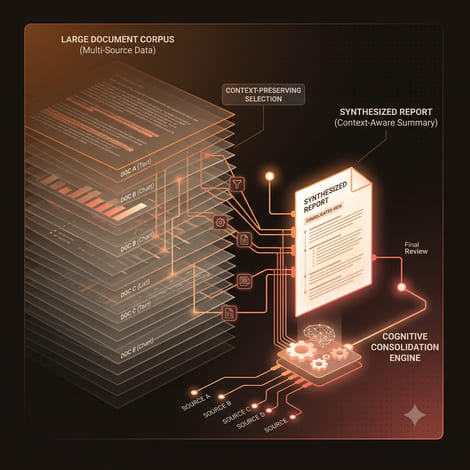
Chunking with context-preserving overlap, metadata tagging, and an embedding pipeline designed around the documents and the questions actually being asked of them.
A writer and reviewer pair
One agent researches and drafts across the corpus. A second verifies every claim against its cited source before the document reaches a person.
Citation grounding by design
Source attribution is part of the response structure from the start, so a reviewer can trace any sentence back to the document it came from.
Hybrid retrieval where precision matters
For corpora where keyword precision matters as much as semantic similarity, keyword and vector search are combined and re-ranked, then tested against real queries.
Evaluation before users, not after complaints
An automated evaluation framework scores answer quality against a representative test set on every deployment, so regressions are caught before release.
Built with
The stack behind it
The lead tier is what makes this system what it is. Everything under it is the platform that carries it.
AI and retrieval
Platform
Governance
What changed
The result in production
4 to 8 hours saved per knowledge worker per week
The research and assembly step compresses to a review step on a drafted, cited document.
Every claim traceable to a source
Output is usable in contexts where an unverifiable answer is worse than none, because the citation is part of the answer.
Answer quality that is measured, not assumed
Evaluation runs on every deployment, so quality is a number the team watches rather than an impression they form.

Same problem?
Let's scope what this would look like for you
Start with a two-week Discovery Sprint. We map your highest-value workflows and deliver a prioritised pilot roadmap grounded in what we have already shipped.