Autonomous NOC Agent
Tier-1 incident response that reads the alert, runs the runbook, and escalates with context.
- Client
- Enterprise network operations teams
- Sector
- Network operations and CMDB
- Our role
- Agent design, build, and operation on our own CMDB platform
- Status
- Running in production
The brief
What was breaking
Tier-1 incident response is a repeatable loop: read the alert, check the CMDB for what it is attached to, run the known runbook, escalate if it does not resolve. It is repeatable enough to automate and important enough that nobody wants to automate it carelessly. The cost of not automating it is a rota of engineers awake at 3am doing a documented procedure.
- Out-of-hours coverage is staffed for alert volume rather than judgment, which is expensive and hard to retain people for.
- Alerts arrive without the CMDB context needed to act, so the first minutes of every incident are spent gathering it.
- Runbooks exist as documents, which means a human has to read, interpret, and execute them under time pressure.
- When an incident is escalated, the context behind what was already tried is often lost in the handoff.
What we built
The system we delivered
Alert enrichment before anything acts
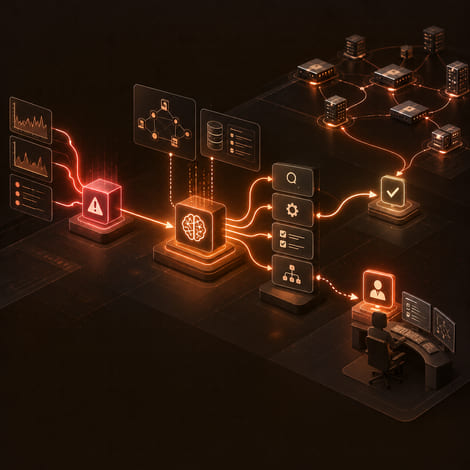
Each event is enriched with its CMDB context and correlated with related alerts, so the agent and any engineer behind it start from the full picture.
Runbook execution the agent can be trusted with
Runbooks are made machine-executable with the safe-versus-risky classification built into the definition, not left to the model's judgment at runtime.
Escalation that carries the work
When the agent genuinely needs a human, it hands over the alert, the configuration items involved, the runbooks it ran, and the results, rather than a ticket number.
CMDB reconciliation as it goes
Discovery data is compared against CMDB records continuously, with high-confidence corrections applied autonomously and the rest raised as change requests.
An audit trail as a property of the workflow
Every decision the agent takes is journalled as part of the graph itself, so the record exists by construction rather than by logging discipline.
Built with
The stack behind it
The lead tier is what makes this system what it is. Everything under it is the platform that carries it.
Platform
Operations
What changed
The result in production
60 to 80% faster incident resolution
The gap between an alert firing and the first corrective action closes to the time it takes an agent to read it.
Over 90% of alerts resolved without waking a human
Engineers are interrupted for the incidents that genuinely need judgment, not for the ones with a documented answer.
Round-the-clock coverage without adding headcount
The same team covers nights and weekends because the repeatable tier-1 loop no longer requires a person to be awake for it.
Same problem?
Let's scope what this would look like for you
Start with a two-week Discovery Sprint. We map your highest-value workflows and deliver a prioritised pilot roadmap grounded in what we have already shipped.